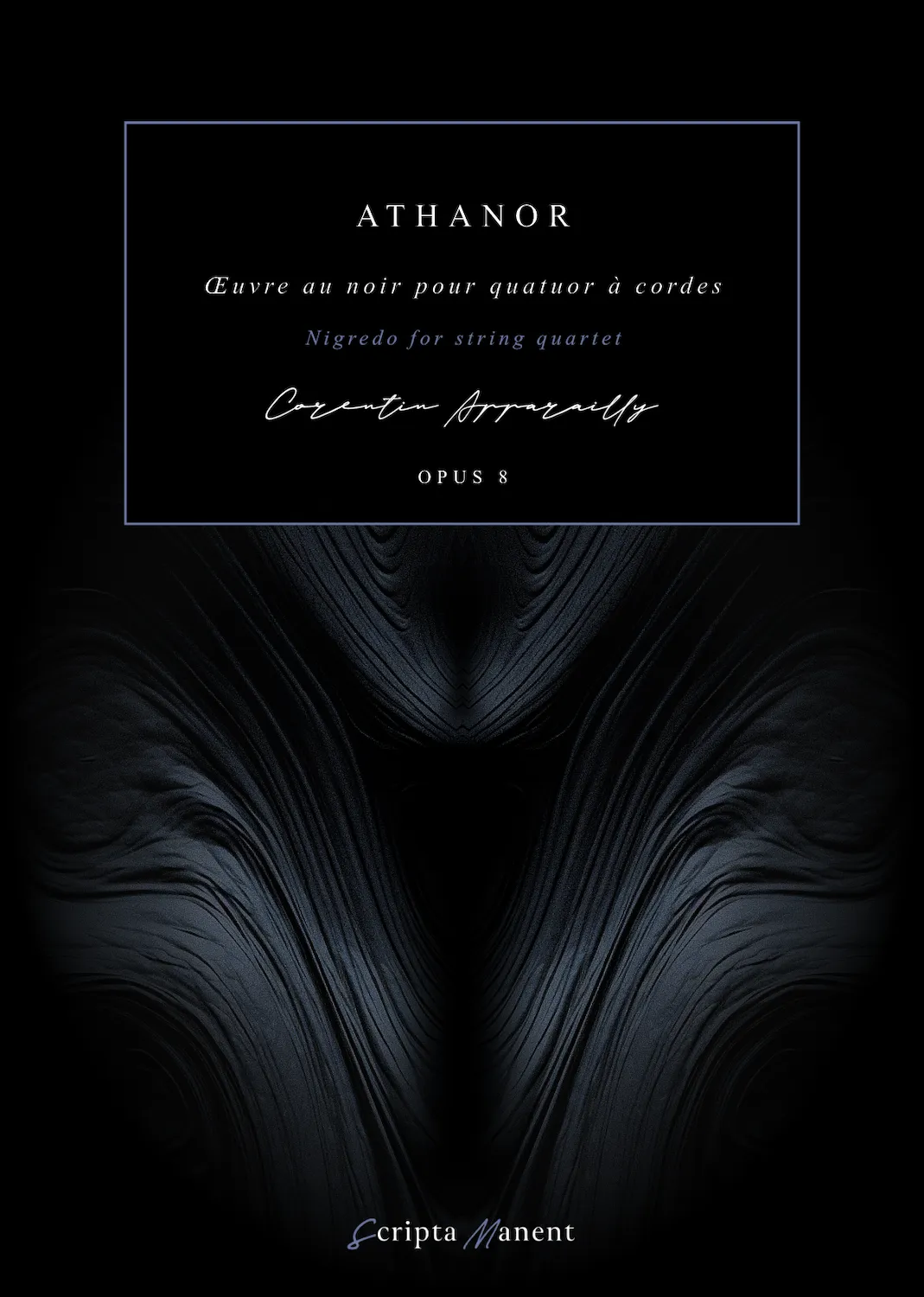
Athanor borrows its name from the furnace that alchemists kept burning day and night, never letting it go out, in the hope of transforming base matter into the philosopher's stone. A relentlessly stoked fire, a constant heat working the matter in secret, far from sight.
The work in black, or Nigredo, is the first stage of the alchemical Magnum Opus: that of dissolution, necessary putrefaction, the chaos preceding all transformation. Nothing can become gold without first losing its initial form, undoing itself, decomposing in the darkness of the crucible. It is this state that the quartet brings to hear: four voices immersed in an as yet formless matter, searching for each other, clashing, dissolving into one another before any clarity is allowed.
But behind the metamorphosis lies a broader quest: that of immortality. Ancient treatises speak of the magnum opus as a sacred rite enabling whoever completes it to conquer death itself. In this, the quest of the alchemist and that of the composer are perhaps not so distant: giving birth, from simple and raw matter, to something precious and touching eternity.